Sina Queyras
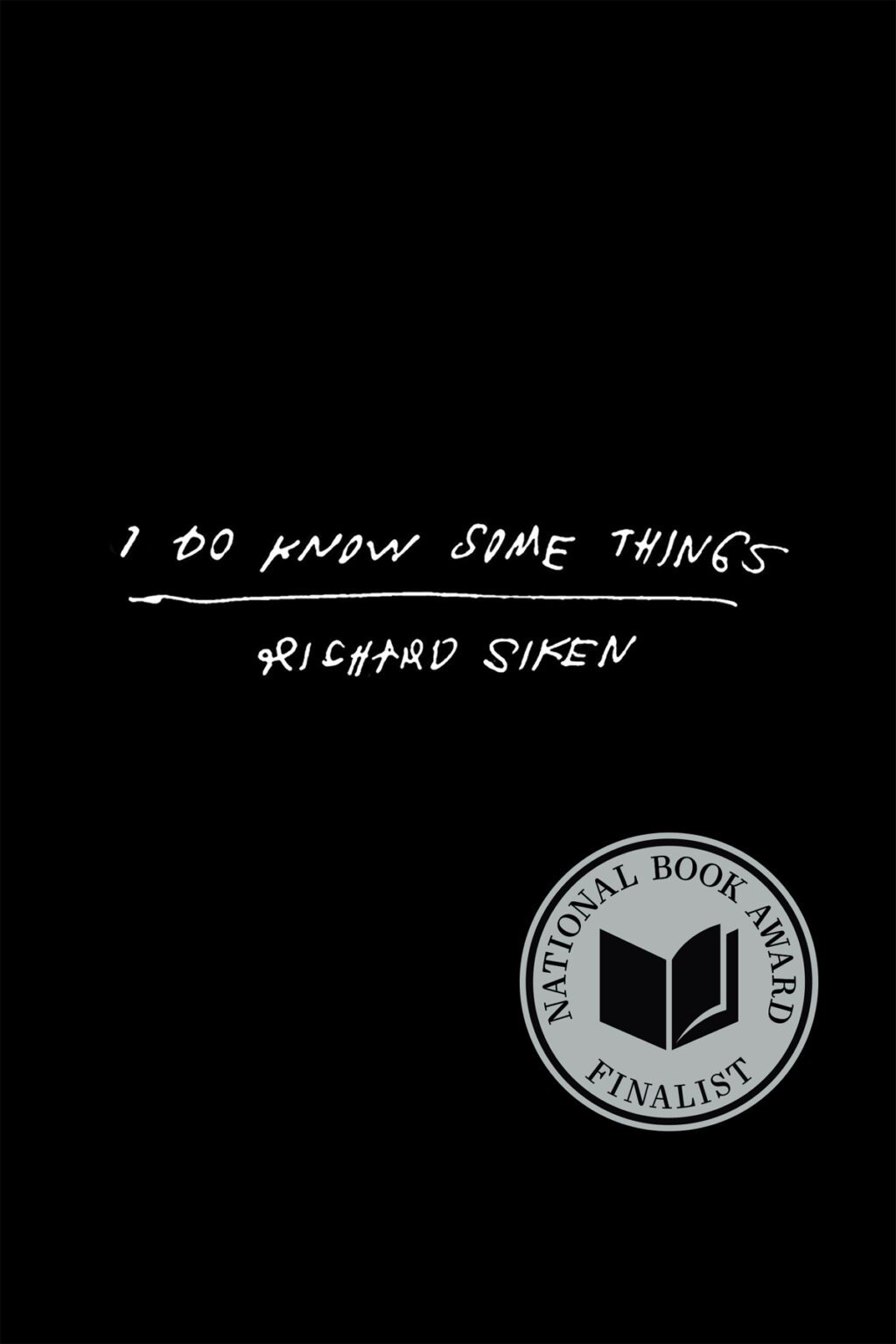
Richard Siken’s book, I Do Know Some Things, has intrigued me for some months now. I was able to resist it when it was hypothetical, scrolling past me on the screen, on posts, ie, when it wasn’t “in my hands.” Once I picked it up though, just before New Years Eve, I couldn’t stop reading.
No really. I could not. Put. The book. Down.
When is the last time you couldn’t move having opened a book and begun reading? What kind of poetry book compels like that? Syntax, voice, form? A tractor beam. Rare enough as to be remarkable. Naturally I bought it.
It happens. Not often, but I live for these moments of insistence. I should make a list. I should just do as I say. Be the thing. Move in the direction of my mind. That’s what this kind of poetry reminds me to do.
Speaking of lists. I have begun a list. I intend to keep track of things. I have no great hope of actually doing so, but I have the intention of containment and even order, around my reading. Reading which has at least doubled since I deleted my social media accounts. That’s another story, but related.
I began this post about Richard Siken in January with the intention of regularly posting reading notes, but then thought, why? We are inundated with posts about books. At the same time there seems so little engagement outside of social media. It feels like a lot of talk while simultaneously suffering a lack of real engagement.
Maybe real is not a good word choice. I don’t mean judgement. I might mean meaningful.
*
I had planned on not posting on social media of any kind for the foreseeable future. I thought that if I have anything to say it will be here (a blog isn’t social media) and largely, what goes here I intended to be about what I have loved or was moved by. What I want to recommend. Or, what I want to argue with out of a sense of urgency. Now I have this blog set up to share on two sites—Threads and Bluesky. I also started an Instagram for the upcoming On Occasion anthology, which I intend to celebrate the hell out of because I love it… But maybe not on social media because even setting up these very bare, new, accounts, filled me with unease. Opening Threads feels like a finger on one nostril hitting the screen for a bump. I never loved that world.
To be clear, I’m not saying that this post, or anything on this site is “real engagement” because I am no longer sure what that is. Is “real” authentic? Extended? More than a snippet? Not AI? (There isn’t a speck of AI here. I don’t use it to the extent that I have a choice.) Is real a thought that weaves in and out of the body? Is poetry real? All poetry? Equally real? Or is some poetry more real? Like this Siken book? If it is, then I would say real is engagement, is gripping, is a body pulsing with desire, unable to move and reporting back from the field. Real doesn’t care. It lifts you by the scruff of the neck and shakes you. It reaches right into your chest; its fingers rope around your heart.
*
The Siken book knocked me out. That’s no small feat, and no exaggeration on my part. I would have finished it in one go had I not had to leave the store I bought it from. I would have finished it the second time I picked it up had I not already had an obligation to leave the sofa where I was reading that afternoon. The third time, later the same day, I finished it. Then I sat there. Do I like this book? I’m amazed by it, yes, but what am I going to do with having read this? This was not how I wanted the first read of the year to go. This is not where I want to be in any way.

There have been other books that have compelled in this way. Some more joyfully than this one. A certain book called The Weather I carried everywhere for several seasons back in 2003. The act of reading this book was not, as it was with The Weather, an uplifting one. It did not make me feel I could soar. It didn’t even make me want to write. It made me marvel. It made me feel devastated. It made me present in the moment. That is some mojo.
I am old enough now where I could care less what people say about feelings and poetry. Or about my poetry. Or my thoughts on poetry. I could care less if the way I think about poetry is not the right way to think. Or the accepted way, or even, au courant. I am interested in repairing my relationship to poetry. Hence my resistance to social media, which makes me feel deeply unmoored, deeply uneasy, upended, not expansive as it once might have… Not full of possibility. But maybe social media never did that?
*
These poems made me feel all of these less positive things. Except that they are real. They are not happy poems. Not really. They are gritty. They choose life. They are alive and so they offer a sensation of connection. A connection to something far beneath what I know. Or what is known. And I mean this in the best way—they tunnel under the detritus which is also in the poems. Objects appear to float in and out as random as language, which the speaker has become cut off from. So there’s a knowing here that is gut level. I know many people who I also have followed for years on Instagram, but I often do not recognize them inside the form of their feed, or the poems necessarily. That is disorienting in a disturbing way.
I don’t know Siken. We sort of corresponded once. I mean, rather, I found myself on the jury with Siken after we both won the Lambda Award. There was no connection. I could have been the waiter, or the doorman for all he noticed. To be fair, I didn’t notice him either. Not until many years later. So, it was unexpected, the way that the poetry gripped me. I found the voice very intimate and disorienting in a disturbing way. Nothing is for sure. “They say I was born in February, in a hospital, in midtown, while it snowed” (11). No one is safe: “The morning after my father killed his first wife, he woke up next to her dead body, rose from their bed, and began his morning routine” (6). The grandmother, mother, brother, no one safe. People the speaker meets in the world. Not safe. “The List,” begins “I tried to say something nice to the nurse. I introduced myself. She said we had already met. I thought she was moody until I realized she was several nurses, each working their own shift” (27). “Describing the world was easier than finding a place in it,” and later in this same poem “I started a second notebook for venom and hard feelings…It was true and harsh and ugly and it made me feel sick” (27).
I find a lot of the poetry of intense revelation disturbing. I’m also drawn to it. Feelings are often not pretty. Emotions can be weather we move through. We have thoughts we wouldn’t want to concretize. I find the way I encounter such poetry on social media slightly more disturbing—but Siken’s poetry was disturbing in way that I felt was–I originally wrote productive but that’s not quite it. Nor is “worthwhile.” It’s a sensation that is more like “authentic.” I realize that could be seen as “relatable” but that’s not quite it. I could also be accused of preferring an experience that somehow echoes some of my own trajectory and timeline. There is no tangible outcome from reading this book. At least not for me. As I said, it didn’t move me to write—this is usually the big test of whether or not I love a book—nor did it move me to recommend it. In fact, I found myself trying to explain to the people I was with—none of whom were poets—how much the book had moved me and then realized that no, I wasn’t going to recommend that they read it.
So what did the book offer? The poet had shattered me in a way that mimicked how he had been shattered and reminded me of times I had experienced similar ruptures. As a goal, I find that an admirable one. Yet as I sat there with the book in my hand I was perplexed. What did this book offer me? What do we glean from being transported so deeply into the misery of others?
Here’s a line from the poem, “Paragraph.” “I didn’t know what to do with it so I put it in a box.” What is it? The pain? The paragraph? Both? You can see the way that trauma shifts the speaker, and us, out of our usual associations. “I adjusted the furniture. A paragraph is like a small town. You have to have stamina.” The latter canned sentiment falls as flat as it’s intended, but it’s also true. You really do have to have stamina in this narrative. You have to, as the Stoics remind us, know your own mind. You have to, because the world will tell you again and again that it knows your mind, and body, better.
I liked so many things about this book. The non-sequiturs. The statements piling up like shavings. The sense of the body in a whirlwind of activity that makes no sense. Anyone who has experienced any kind of trauma, from the most intense physical pain to the great trauma of unrequited love can recognize this level of disorientation and the way it makes (or reveals the possibility of making) the world new. I bet there are more fresh images in this book than a stack of other random prize-winning poetry titles published in the last five years. There are syntactical marvels. There is narrative propulsion. There are sentences that pain to encounter. I must also say that the book is a grueling journey. Bad shit happens. It gets worse. Here’s a snippet from a recent review in The Guardian that explains:
“In 2019, Siken suffered a serious stroke, an event he uses as a way of thinking about memory, loss and language itself: “I was having trouble with my tenses – is, was, will be – and things were getting lost in the overlap.” The slipperiness of the subject, loquacious, implacable and revelatory, asks us to delight in the lie as an honest riposte to a private life lived in public view.” Sandeep Parmar
A private life “lived” in public view. Sort of like being on social media. Having one’s innards splayed across the tarmac of a reels thread. Like watching William Gass being dragged through town during a wind/flood/cyclone storm. What strikes one immediately is the intense vulnerability but also the stoicism of the speaker. The ability to hang on and witness.
So, there’s a reason for this ungroundedness. It’s not random. We aren’t lost in an algorithm designed to make the .1% more and more money as many of us now spend a good portion of our days. No, we are in a poem, in a human body and mind suffering through and trying to process an event. An occasion even. Not a great occasion. Navigating a physical, medical, intellectual and systemic crisis.
The urgency in some ways reminds me of CAConrad, someone who has been on my radar for years, and who, like myself and Siken, came out at the onset of the AIDS crisis and watched as it raged through our communities. Coming out that way you understand how hard you have to fight to keep your version of events top of mind to survive mentally, let alone survive physically, and how ridiculous your own survival is. How tentative the wins.
The poems themselves appear to be aware of the many levels at work at once, though also somewhat surprised by the depths of what they reveal. This appears to be intentional. At least the author that is Richard Siken spent some months teasing out the “backstage pass” theme on his social media accounts prior to the book’s publication. Even so, the poems reveal as much to the speaker as to the reader, and that is part of the electricity, the propulsion. The astonishment in these poems is ongoing and multi-directional (as the grammatical dissolution and syntactic explosion) a sensation more and more of us are understanding as the world around us, the systems of governance, of care, of relation, appear to dissolve: “I once described a forest as a box of leaves. You can put words around anything, even an absence” (101). As you can see, these are not poems that rely solely on confession, though that is what is thrumming through them; confession with writerly precision and decision, is description. Description is one fuel. More importantly, every utterance contains its own conflict.
Statement. Overstatement. Understatement.
Or, perhaps what is happening is that there is space between the speaker and the actions of the speaker, and in the gap, there is so much art. I tried to explain this to a student who had walked in to my office while writing this paragraph. Most poetry, if its complex at all, deals with strands like this I said, stacking three pencils on top of each other. Siken’s book is like this, I said, taking the pencils in the air as if they were crossing each other, and floating apart. You hold the strands and you let associations build in between those strands. You don’t draw conclusions. You observe and gather.
This happens in all art. Maybe even in this review, maybe this one as it turns out, that is moving associatively, coalescing as a record, if not a matter of lived experience. I am here, the reader/reviewer says. I experienced this book. It was more than an accessory. It was more than a punctuation mark in my own story. It was more than a reel I swiped.
I am trying to work out what this book has done to me. How it has impacted my thinking. I want to describe it and in so doing perhaps gain some understanding of how the poems are working. And how I am working. Reading isn’t passive. I am not nowhere when I am reading. Or when I am writing. And whether a/ this is important and b/ why it matters. If I get angry at a book it’s generally because it means something I don’t want to know.
*
And here I pause to reflect on the fact that the poems are prose poems and surely this is part of the draw for me, and also necessary to the project because received forms would constrain the poems—the way that in Frank, Diane Seuss lets the line of her sonnets extend so far they are nearly off the page and at least in one instance, force a double page. Being present it turns out, takes space. It makes space. It’s a kind of nod to the beautiful limitations of the form as well as the conventions of the content. Or, the way that content dictates or maybe even renovates form if you truly experience it. Unfiltered is how I might describe both Seuss and Siken.
Like Seuss’s sonnets, Siken’s form is expansive. Or, you could say there is no form. You could say niceties such as line breaks have to get out of the way because of lyric propulsion. Not that all propulsive poems explode into prose, but that lyricism, of course, can be full throttle. More like spillage, more like a monologue; downhill all the way. That’s what a prose poem can do f—kers. I suppose I have a weakness for such verse. Prose with force. Velvet waves with a tumult of hooks.
A kind of lyric accumulation, this forceful gathering—a concept I haven’t thought about in a few years, but yes, like the snow-rollers I witness on the mountain near my home in Montreal; a small patch of snow lifts off for some reason and begins rolling down the side of the mountain landing, with a soft thud, on its side, very often just at the edge of the ski trail, like little Danish filled with the banal news of the slope.
Lyric force. Lyric accumulation. Hold on and roll. At the core of lyric conceptualism is the triangulation of the lyric self, first the creation of an observing self that is both witness and other and engaged with some other force—form, obstruction, time, dead language. My landing on Lyric Conceptualism came honestly. A lyric poet takes a detour in Conceptual poetry and what happens? But that question is for another time.
What can I take away from Siken’s book? All news gathers force. You don’t have to suffer a stroke to be awake to your body in its moment of crisis. You could simply be present, now, with the appropriate amount of rage, and will to live, and to document. And shape your poem.
Leave a Reply